Analyse
Muster, Abweichungen und Handlungsfelder in ihrem Prozesskontext erkennen.

AI in operations
AI becomes valuable once it understands the data, the process and who is accountable – embedded, traceable and under control.
Muster, Abweichungen und Handlungsfelder in ihrem Prozesskontext erkennen.
Relevante Informationen passend zur Aufgabe verdichten.
Stammdaten strukturiert ergänzen, prüfen und verbessern.
Ergebnisse geordnet zurück in den operativen Ablauf führen.
Productive today
These AI building blocks run in daily operations – embedded in ERP processes, with human approval and a complete audit trail.
Purchase orders arriving as PDF or email become structured draft sales orders – in 18 languages.
Supplier confirmations are compared against the order: dates, prices and article numbers. Deviations are flagged, never silently applied.
Incoming invoices are checked against orders and goods receipts before anyone approves a payment.
Incoming mail is classified and routed to the right lead, ticket or task – with the full context attached.
Responses are prepared in the right business context. People review, adjust and send.
Company knowledge
It sits in PDFs, spreadsheets, drawings, database rows and ticket histories – across several systems and file formats. Full-text search finds the file. It does not find the answer. That is why "we documented that" and "nobody can find it" are true at the same time.
A knowledge server is one governed way in to all of it – not a chatbot bolted onto a folder. People and agents ask in a sentence. The server decides per user what may be seen, retrieves from your own sources and puts the source next to the answer.
Quotations, orders, supplier mail, internal standards and manuals. Asked in a sentence, answered with the passage it came from.
Price lists, condition matrices, planning sheets. The row that matters, instead of the file it is buried in.
Live from the ERP: customers, orders, stock, history. Current at the moment of the question, not a nightly copy.
CAD and STEP files become findable by what they are, not by what someone once named the file.
Photography, labels and scanned datasheets, retrievable by what is in them.
What was already asked, answered and solved. The second customer with the same problem gets the first customer's answer.
The server answers inside the rights the person already has. Nobody sees more through the assistant than in the system itself.
A statement you cannot check is worth nothing in a business decision. Answers name the document, the record or the row they came from.
Only the excerpt relevant to the task travels to the model, through the governed channel. API data is not used for training.
Where the knowledge is not there, the honest answer is that it is not there. That is a design decision, not a shortcoming.
Six retrieval services run in STASTO production today – over documents and correspondence, product data, images, 3D models, support history and web analytics – plus the company knowledge chat inside Odoo.
The control plane
The Corelane AI Cockpit is the control plane for all AI on the platform: every agent, team and workflow is operated, approved and accounted for in one place.
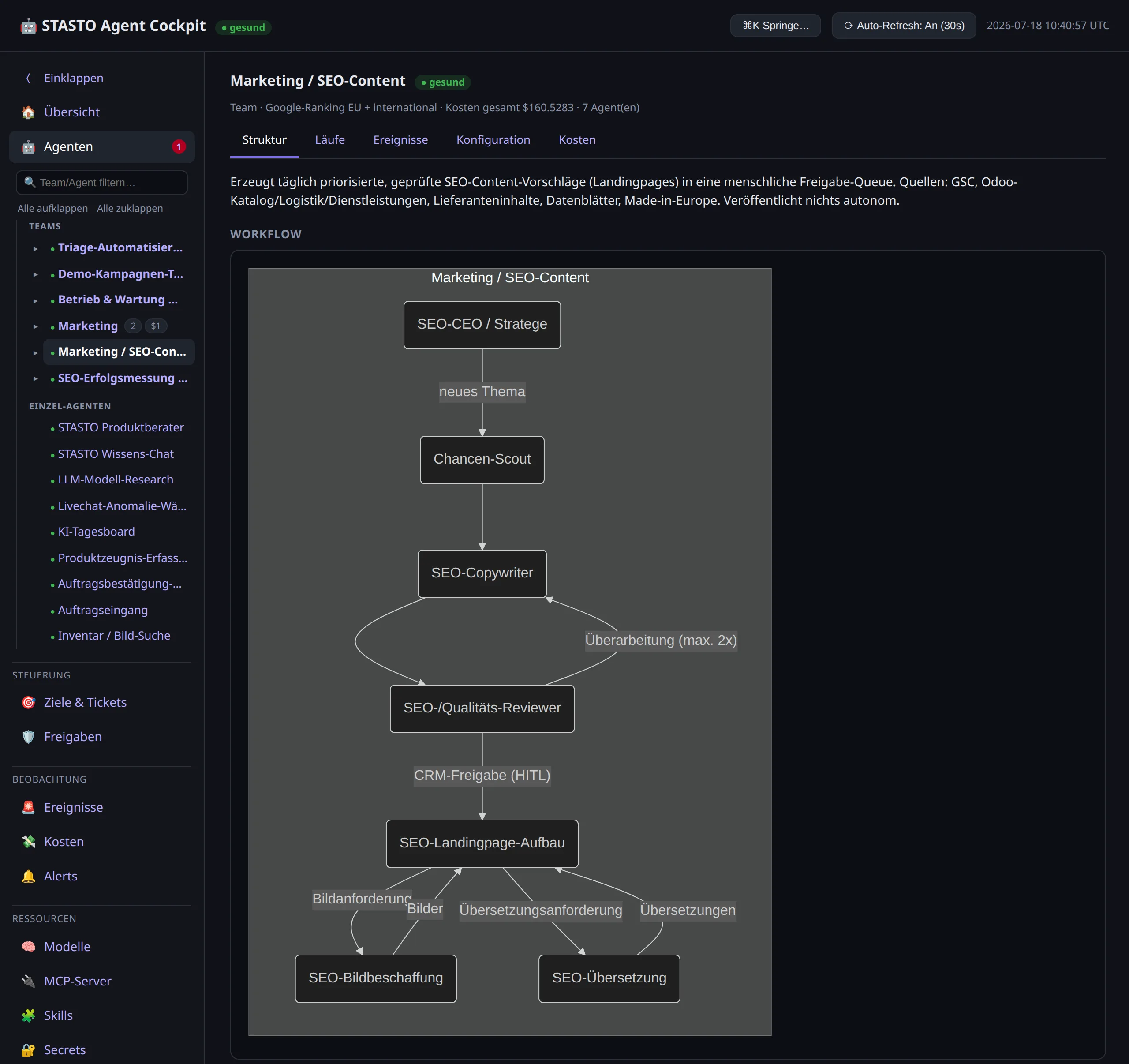
From email triage to document capture: every AI workflow runs as a managed agent with schedule and health check.
Suggestions with business impact wait in the approval queue – people release them, not models.
Every model call is metered: costs per agent, per workflow and per day – with hard budget limits.
Every action, decision and configuration change is logged and traceable.
Language models, MCP servers, skills and secrets are managed centrally – swappable without code changes.
A daily error review analyses failures and automatically heals known patterns.
Status: in daily production at STASTO today. For customers it ships as part of Corelane Operate – the same cockpit, not a roadmap item.
External AI models
Corelane uses leading language models such as Anthropic Claude or OpenAI – through one governed channel instead of browser tabs. The data truth stays in the house.
Every model call runs through the platform: prompts are built by code, metered and logged, and the provider keys live in the control plane rather than in the ERP database – instead of customer data ending up in private chat windows.
The model is a language processor, not a data store: only the task-relevant excerpt travels, knowledge comes from your own sources via retrieval – API data is not used for training.
The model is configuration per workflow: leading providers, European alternatives or local models – sensitive workflows can run EU-only or on premise.
API use with data processing agreements, standard contractual clauses and zero-retention options – plus budgets and a complete audit trail for every call.
The instructions a model works from are configuration, and configuration gets changed. So every change is scored against a reviewed set of real cases and compared with the last run. Without that, one click on Save silently changes how a thousand mails a day are classified – and nobody notices until a customer does.
Token cost per call in a ledger, a budget per workflow, a watchdog over cost and health. AI spending becomes a line you can read at the end of the month instead of a surprise on an invoice – and an expensive workflow shows up while it is still cheap to fix.
The alternative to governed AI is not "no AI" – it is shadow AI. Corelane replaces it with one controlled channel.
Next step